Skip to content

SDLCAI 2026 / From the recordings

Talk summaries

Revisit the ideas from all ten talks. Explore timestamped key points, follow the full recordings and share a takeaway card.

Ten talks. Fifty key points.

Editorial summaries paraphrase the speakers’ arguments, with links to the passages they draw on. Each talk includes landscape and portrait graphics with speaker photos, post copy and image alt text.

Explore the programme & materialsDownload all 20 graphics & post copy (ZIP)

The talks

10 talks · 50 timestamped key points

01

35:50 recording

Measure the bottleneck. Mo Khazali at SDLCAI 2026. Three paraphrased talk takeaways: 1. Tool activity alone does not establish customer value. 2. Turn recurring mistakes into checks and shared blueprints. 3. Track flow, failures, rework and customer outcomes. sdlcai.org

Mo Khazali

1978: The Last Good Year

Mo Khazali uses automotive and factory-history analogies to argue that AI adoption needs a redesigned delivery system. Shared platforms, daily learning, early quality checks and customer-outcome measures matter more than token consumption or code output alone.

Read summary
02

32:09 recording

Keep the delivery loop connected. Ohans Emmanuel at SDLCAI 2026. Three paraphrased talk takeaways: 1. Keep intent available to implementation, QA and operations. 2. Separate implementation from QA; combine adaptive and deterministic checks. 3. Feed production findings into the next plan and review. sdlcai.org

Ohans Emmanuel

Zero-trust harnesses for agentic software delivery

Ohans Emmanuel describes a connected delivery workflow that treats agent output as something to verify. Shared intent, early plan review, paired models, visual system understanding, independent QA and production feedback form a loop from deciding what to build through learning from what ships.

Read summary
04

22:39 recording

Make discovery tangible. Tapio Pitkäranta at SDLCAI 2026. Three paraphrased talk takeaways: 1. Give people a probe they can inspect and challenge. 2. Test the understanding of the problem as well as the solution. 3. As building accelerates, ideas, orchestration and validation matter more. sdlcai.org

Tapio Pitkäranta

The Agentic Probe: The Instrument of Agentic Discovery & Engineering

Tapio Pitkäranta presents agentic probes as tangible experiments that help people clarify problems and explore solutions. Examples from a probe factory and a healthcare process exercise show how faster implementation can move the bottleneck toward ideas, orchestration and validation.

Read summary
05

19:22 recording

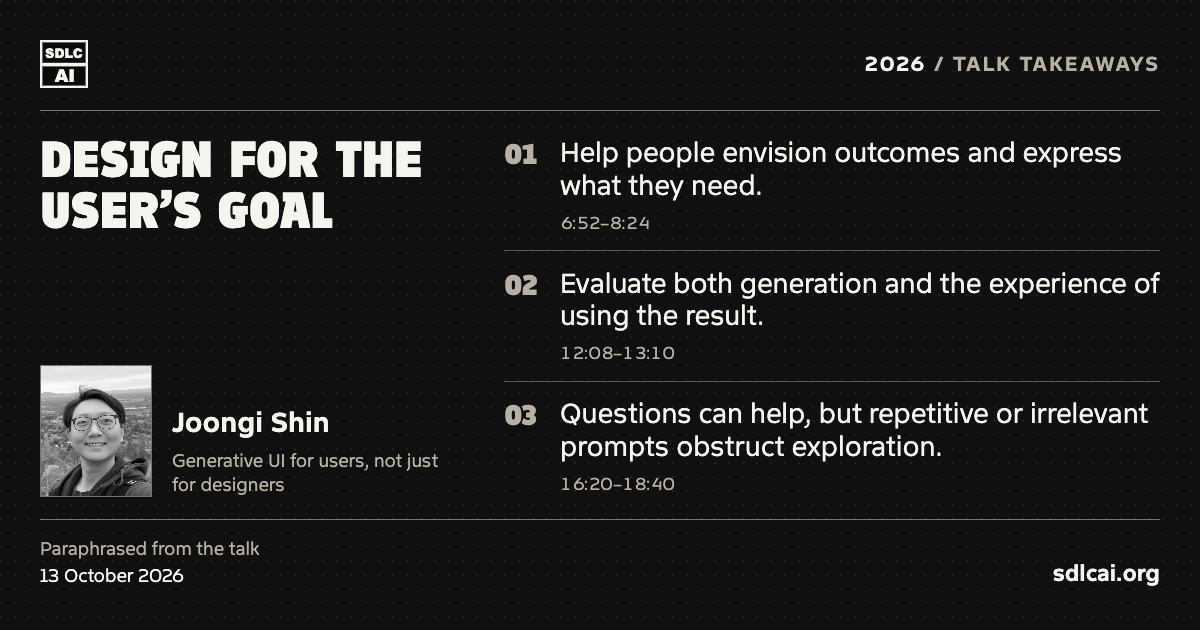
Design for the user’s goal. Joongi Shin at SDLCAI 2026. Three paraphrased talk takeaways: 1. Help people envision outcomes and express what they need. 2. Evaluate both generation and the experience of using the result. 3. Questions can help, but repetitive or irrelevant prompts obstruct exploration. sdlcai.org

Joongi Shin

Generative UI for users, not just for designers

Joongi Shin studies generative UI for people who want to complete a task, rather than design an interface. His comparison of prompts, editable subtask representations and follow-up surveys shows why helping users form and express their intentions matters alongside generating working software.

Read summary
06

20:47 recording

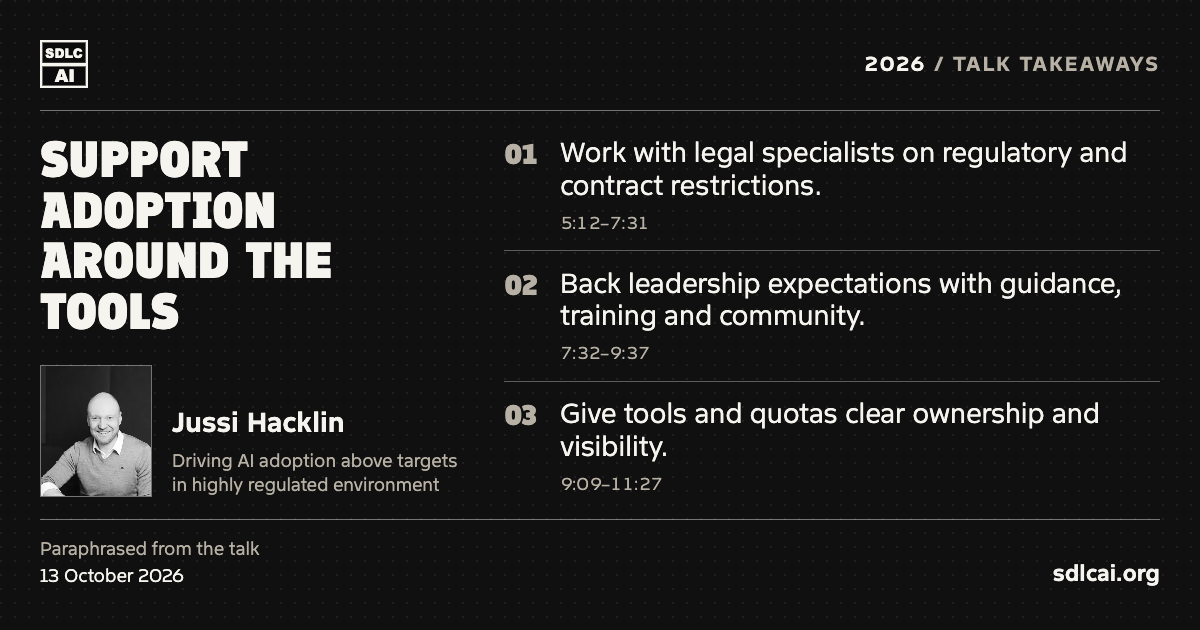
Support adoption around the tools. Jussi Hacklin at SDLCAI 2026. Three paraphrased talk takeaways: 1. Work with legal specialists on regulatory and contract restrictions. 2. Back leadership expectations with guidance, training and community. 3. Give tools and quotas clear ownership and visibility. sdlcai.org

Jussi Hacklin

Driving AI adoption above targets in highly regulated environment

Jussi Hacklin describes how Elisa supports AI adoption within regulatory and customer-contract constraints. Legal collaboration, clear leadership expectations, practical guidance, shared tooling and bounded experiments form the basis for adoption across the software lifecycle.

Read summary
07

22:15 recording

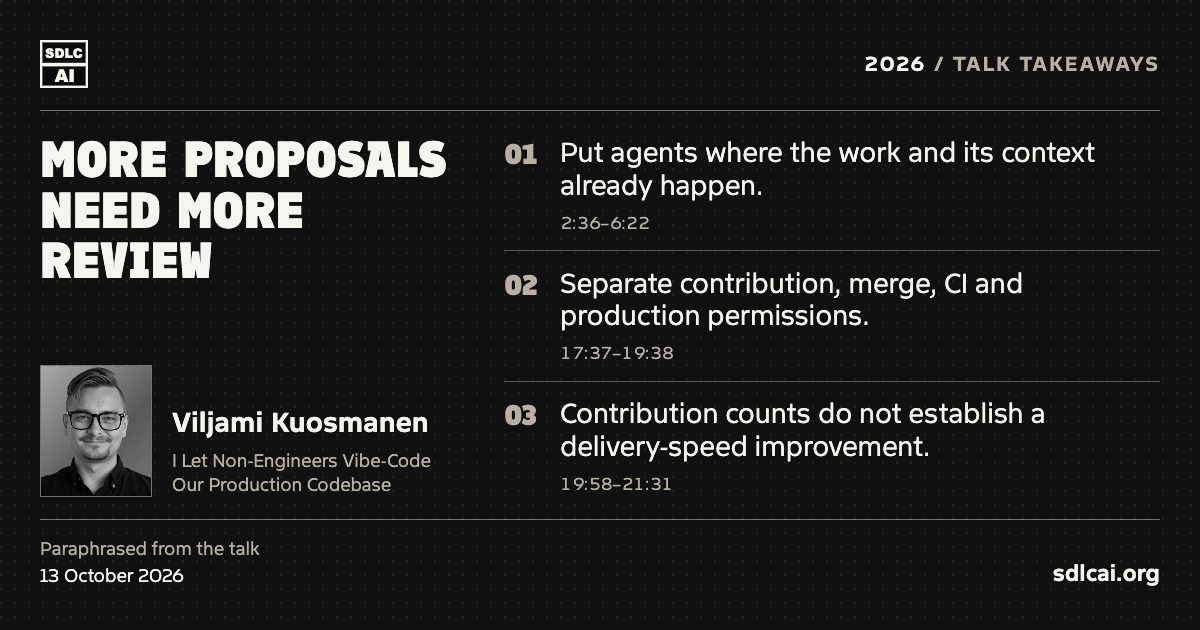
More proposals need more review. Viljami Kuosmanen at SDLCAI 2026. Three paraphrased talk takeaways: 1. Put agents where the work and its context already happen. 2. Separate contribution, merge, CI and production permissions. 3. Contribution counts do not establish a delivery-speed improvement. sdlcai.org

Viljami Kuosmanen

I Let Non-Engineers Vibe-Code Our Production Codebase

Viljami Kuosmanen describes epilot's experiment giving non-engineers coding agents through Slack. Shared documentation, preview links and engineer review enabled contributions across product, design, support and QA, while a deployment near miss exposed permission gaps and review became a bottleneck.

Read summary
08

28:10 recording

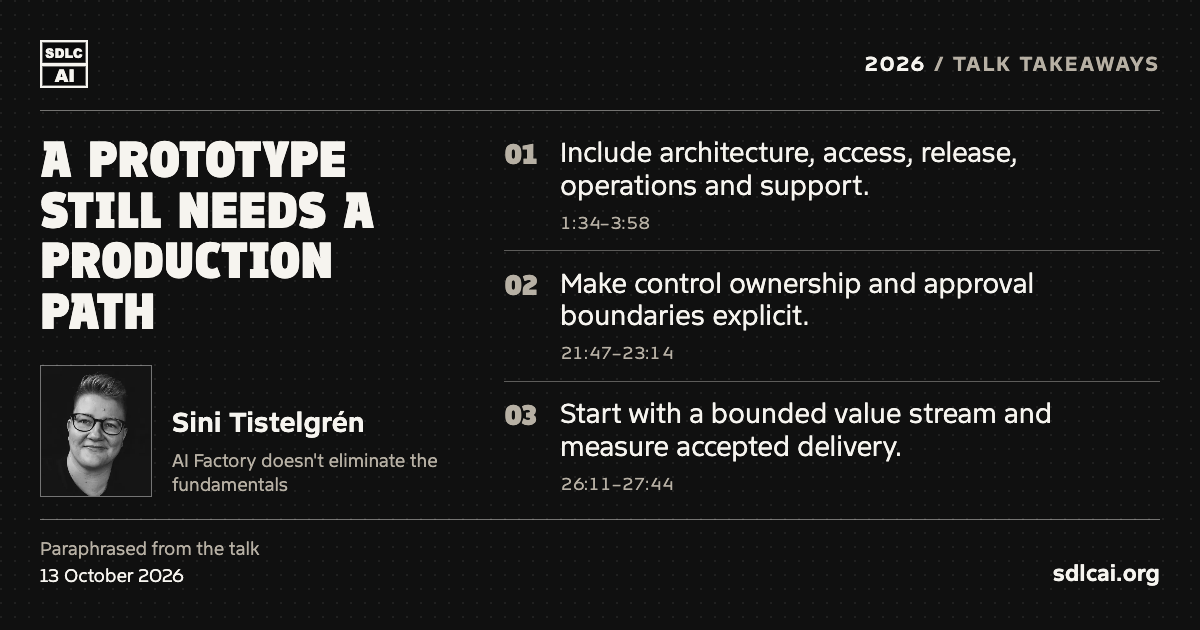
A prototype still needs a production path. Sini Tistelgrén at SDLCAI 2026. Three paraphrased talk takeaways: 1. Include architecture, access, release, operations and support. 2. Make control ownership and approval boundaries explicit. 3. Start with a bounded value stream and measure accepted delivery. sdlcai.org

Sini Tistelgrén

AI Factory doesn't eliminate the fundamentals

Sini Tistelgrén describes an AI factory as a delivery system built on intent, architecture, security, independent verification, ownership and operational feedback. She explains why a quick prototype still needs a production path, and proposes bounded loops with executable controls and evidence.

Read summary
09

20:55 recording

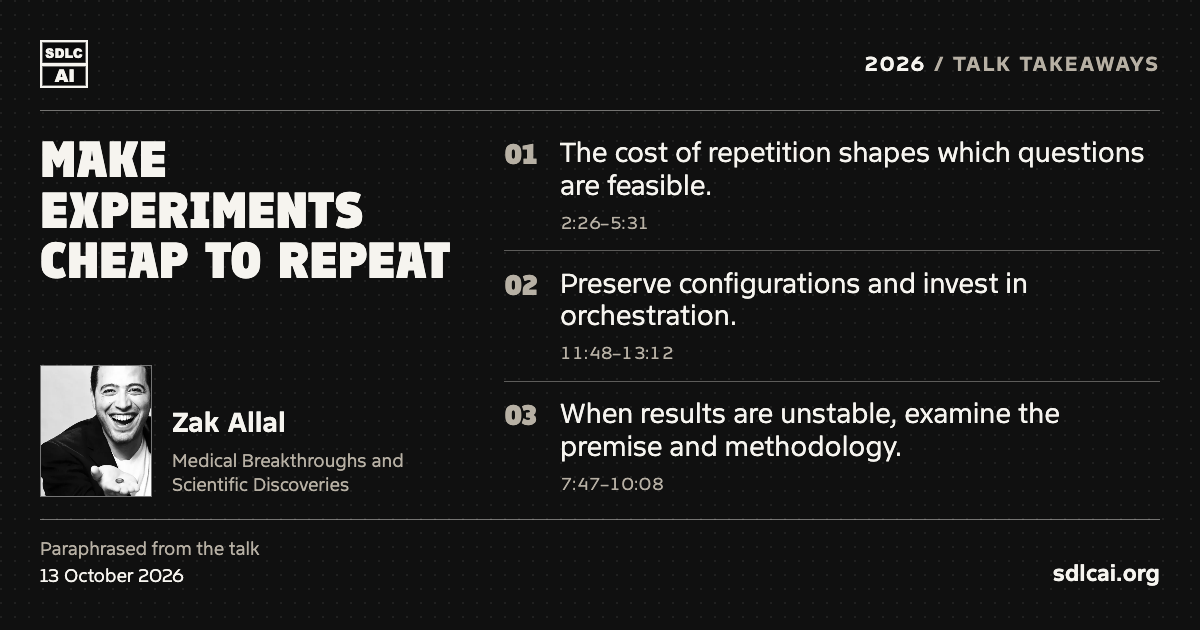
Make experiments cheap to repeat. Zak Allal at SDLCAI 2026. Three paraphrased talk takeaways: 1. The cost of repetition shapes which questions are feasible. 2. Preserve configurations and invest in orchestration. 3. When results are unstable, examine the premise and methodology. sdlcai.org

Zak Allal

Medical Breakthroughs and Scientific Discoveries

Zak Allal argues that lowering the cost of repeating experiments can change scientific discovery. He describes a clinical research system built with supercomputing, Rust, Julia and C++, and presents a proposed continuous hearing atlas as an example of questioning the assumptions behind existing categories.

Read summary
10

30:54 recording

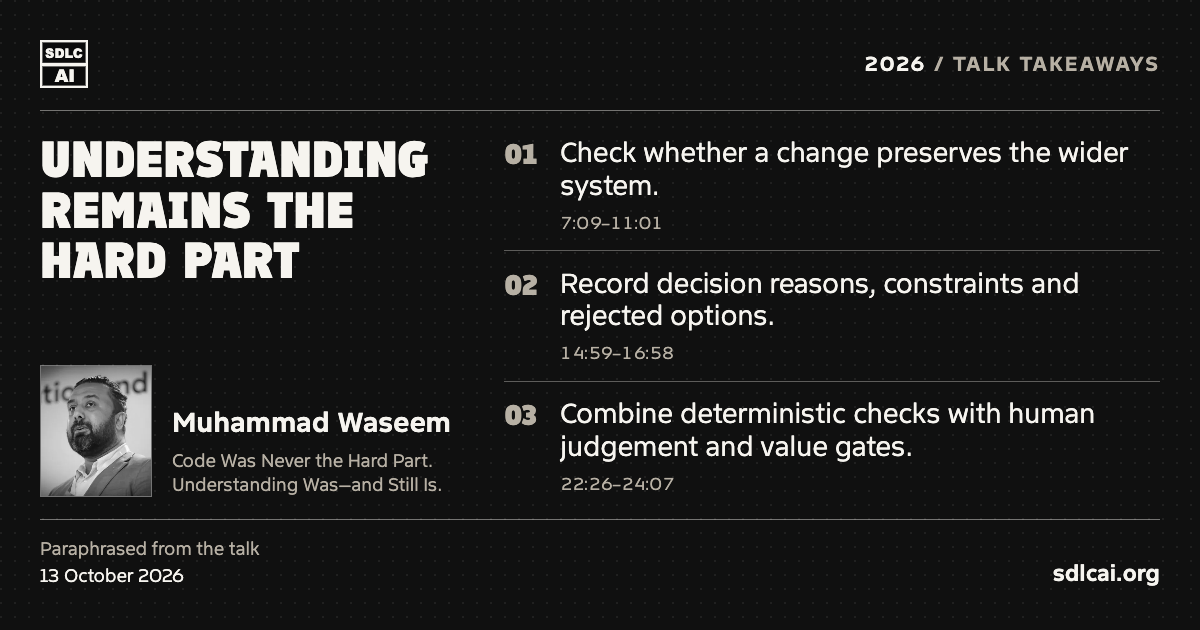
Understanding remains the hard part. Muhammad Waseem at SDLCAI 2026. Three paraphrased talk takeaways: 1. Check whether a change preserves the wider system. 2. Record decision reasons, constraints and rejected options. 3. Combine deterministic checks with human judgement and value gates. sdlcai.org

Muhammad Waseem

Code Was Never the Hard Part. Understanding Was—and Still Is.

Muhammad Waseem argues that AI makes code generation easier while understanding, integration and ownership remain difficult. He examines repository context, decision rationale and agent-facing applications, then proposes deterministic checks, human judgement and gates for safety, architectural fit and measurable value.

Read summary