SDLCAI 2026 / Talk summary
Mo Khazali
1978: The Last Good Year
Mo Khazali uses automotive and factory-history analogies to argue that AI adoption needs a redesigned delivery system. Shared platforms, daily learning, early quality checks and customer-outcome measures matter more than token consumption or code output alone.
- lean software delivery
- AI adoption
- platform engineering
- continuous improvement
- quality gates
- delivery metrics
- customer value
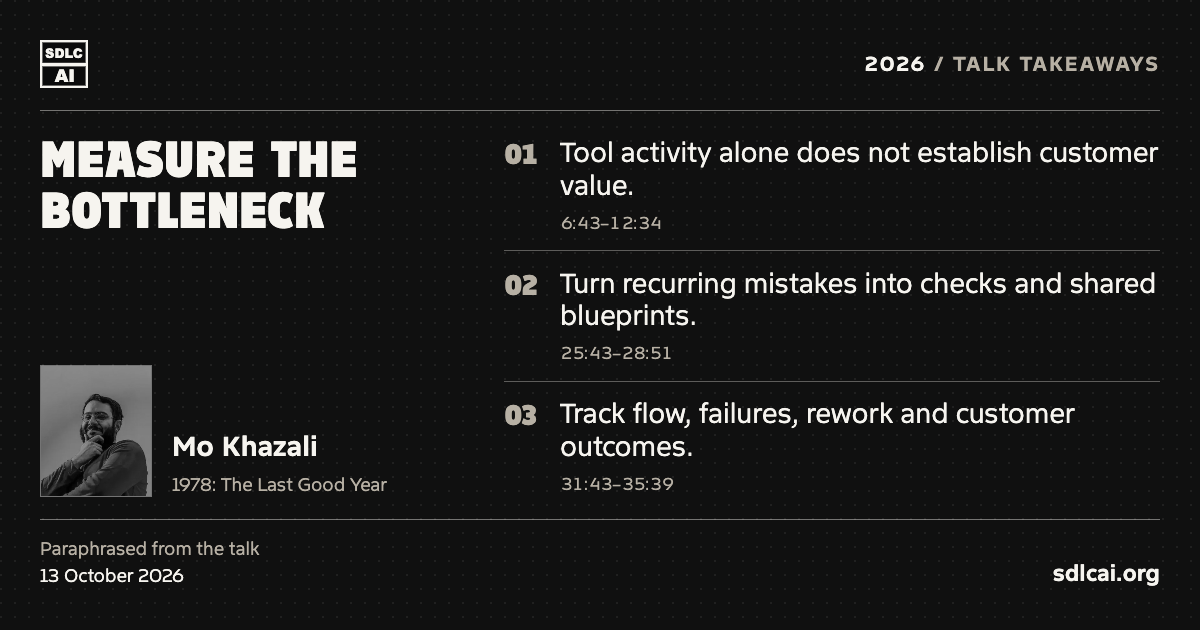
Takeaway graphic
Share three selected takeaways from this talk. Download a landscape or portrait card, with suggested post copy and image alt text.

Read post copy & alt text
Suggested post copy
Measure the bottleneck Three takeaways from Mo Khazali at SDLCAI 2026: 1. Tool activity alone does not establish customer value. 2. Turn recurring mistakes into checks and shared blueprints. 3. Track flow, failures, rework and customer outcomes. Paraphrased from “1978: The Last Good Year”. Watch the full talk: https://www.youtube.com/watch?v=l8quIPHmakI #SDLCAI
Image alt text
Measure the bottleneck. Mo Khazali at SDLCAI 2026. Three paraphrased talk takeaways: 1. Tool activity alone does not establish customer value. 2. Turn recurring mistakes into checks and shared blueprints. 3. Track flow, failures, rework and customer outcomes. sdlcai.org
Key points
Paraphrased from the talk. Follow each timestamp to hear the argument in context.
Tool adoption and activity measures do not by themselves demonstrate customer value or an improved delivery system.
6:43–12:34An AI platform team can turn local solutions into shared model access, observability, skills, standards and support.
16:44–19:14Daily experiments and root-cause discussions develop a learning culture beyond a one-off rollout or workshop.
19:15–25:43Reference blueprints and deterministic rules can prevent known classes of mistakes and reduce repeated correction.
25:43–28:51Audit the whole flow and track outcomes, failures, rework and customer value as bottlenecks shift toward deciding what to build.
31:43–35:39
The talk in context
Mo Khazali compares today's AI adoption with manufacturers investing in automation while leaving their working systems largely unchanged. Through the Detroit, NUMMI and factory-electrification stories, he argues for redesigning the flow of work rather than expecting better tools to repair an organisation by themselves. He applies ideas from the Toyota production system and the Lean Tech Manifesto to software: an AI platform team shares useful building blocks, teams practise daily problem-solving, reference blueprints and deterministic checks catch recurring defects, and the working week is adapted to the team's actual constraints. His examples emphasise learning from friction and feeding local improvements back into the wider organisation. He closes by shifting attention toward what to build and how to measure it: delivery flow, failures, recovery, rework and value for customers, rather than licences, token leaderboards or generated code volume.
Context & qualifications
- The internal pilot comparison is observational; it does not isolate the effects of AI from changes to the delivery process.
Continue with another talk
Explore related questions across the seminar.
Generation changes the delivery system
Viljami Kuosmanen
I Let Non-Engineers Vibe-Code Our Production Codebase
Generation changes the delivery system
Sini Tistelgrén
AI Factory doesn't eliminate the fundamentals
Generation changes the delivery system
Ohans Emmanuel