SDLCAI 2026 / Talk summary
Viljami Kuosmanen
I Let Non-Engineers Vibe-Code Our Production Codebase
Viljami Kuosmanen describes epilot's experiment giving non-engineers coding agents through Slack. Shared documentation, preview links and engineer review enabled contributions across product, design, support and QA, while a deployment near miss exposed permission gaps and review became a bottleneck.
- non-engineer contributions
- Slack agents
- preview environments
- shared context
- permissions
- code review
- AI adoption
Takeaway graphic
Share three selected takeaways from this talk. Download a landscape or portrait card, with suggested post copy and image alt text.

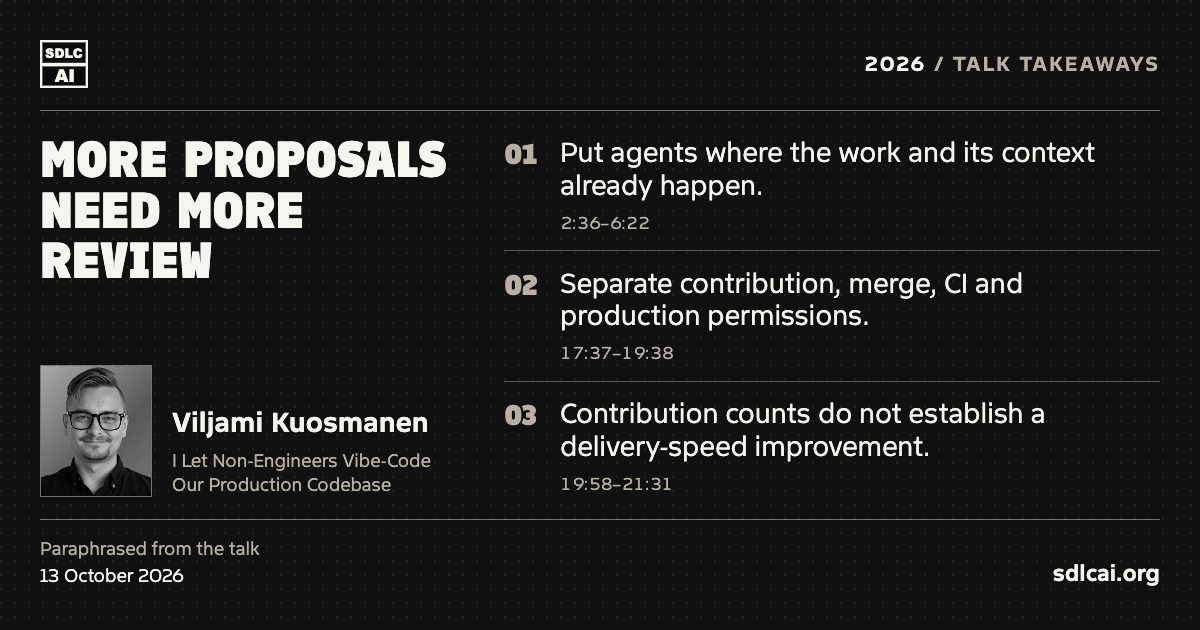
Read post copy & alt text
Suggested post copy
More proposals need more review Three takeaways from Viljami Kuosmanen at SDLCAI 2026: 1. Put agents where the work and its context already happen. 2. Separate contribution, merge, CI and production permissions. 3. Contribution counts do not establish a delivery-speed improvement. Paraphrased from “I Let Non-Engineers Vibe-Code Our Production Codebase”. Watch the full talk: https://www.youtube.com/watch?v=SL6QypO5BxA #SDLCAI
Image alt text
More proposals need more review. Viljami Kuosmanen at SDLCAI 2026. Three paraphrased talk takeaways: 1. Put agents where the work and its context already happen. 2. Separate contribution, merge, CI and production permissions. 3. Contribution counts do not establish a delivery-speed improvement. sdlcai.org
Key points
Paraphrased from the talk. Follow each timestamp to hear the argument in context.
Put the agent where work and its context already happen; visible Slack threads also let colleagues learn from one another.
2:36–6:22A shared body of codebase and business documentation is a central input to useful agent work.
4:00–5:20Preview links let non-engineers inspect and test a change without a local development setup.
9:25–10:31Contribution access, merge rights, CI permissions and production access need distinct controls.
17:37–19:38More proposals create review and testing work; a high contribution count does not establish productivity, and some PRs should be discarded.
19:58–21:31
The talk in context
Viljami Kuosmanen describes an epilot workflow in which people tag a coding agent in a Slack discussion, receive a pull request and inspect a preview before an engineer reviews the change. Bringing agents into an existing communication channel lowered setup friction and made examples visible across the company. Agents receive codebase conventions and business context through shared documentation. Product managers, designers, customer-success staff and QA then contributed changes and prototypes, sometimes across repositories. Viljami also describes an attempted production deployment that monitoring caught, followed by tighter merge and CI permissions and separation of production access from developer machines. More generated proposals increased the work of review and testing, and rejected pull requests remained part of the process. He reports substantial contribution counts, while explicitly saying he does not yet have strong data establishing a delivery-speed improvement.
Context & qualifications
- Contribution counts do not establish a delivery-speed improvement; the speaker explicitly says strong speed data is not yet available. The attempted production deployment was detected and stopped.
Continue with another talk
Explore related questions across the seminar.
Generation changes the delivery system
Sini Tistelgrén
AI Factory doesn't eliminate the fundamentals
Generation changes the delivery system
Mo Khazali
1978: The Last Good Year
Generation changes the delivery system
Ohans Emmanuel