SDLCAI 2026 / Talk summary
Sini Tistelgrén
AI Factory doesn't eliminate the fundamentals
Sini Tistelgrén describes an AI factory as a delivery system built on intent, architecture, security, independent verification, ownership and operational feedback. She explains why a quick prototype still needs a production path, and proposes bounded loops with executable controls and evidence.
- AI factory
- enterprise architecture
- independent verification
- operational feedback
- governance
- delivery metrics
- ownership
Takeaway graphic
Share three selected takeaways from this talk. Download a landscape or portrait card, with suggested post copy and image alt text.

Read post copy & alt text
Suggested post copy
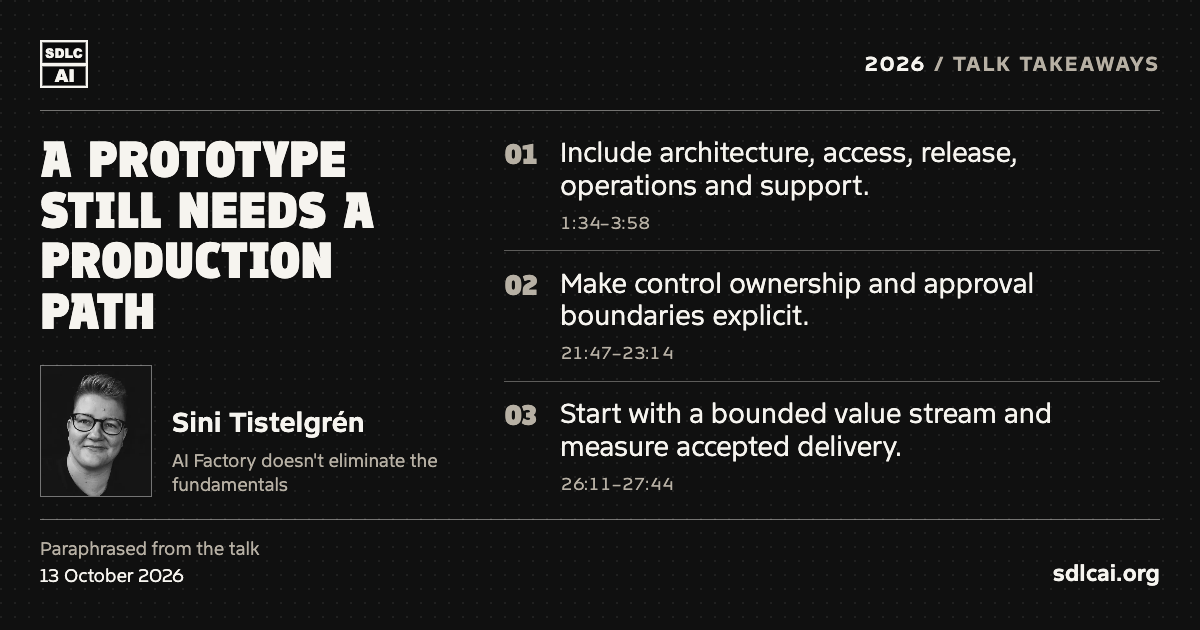
A prototype still needs a production path Three takeaways from Sini Tistelgrén at SDLCAI 2026: 1. Include architecture, access, release, operations and support. 2. Make control ownership and approval boundaries explicit. 3. Start with a bounded value stream and measure accepted delivery. Paraphrased from “AI Factory doesn't eliminate the fundamentals”. Watch the full talk: https://www.youtube.com/watch?v=tOGTv8fR4Wc #SDLCAI
Image alt text
A prototype still needs a production path. Sini Tistelgrén at SDLCAI 2026. Three paraphrased talk takeaways: 1. Include architecture, access, release, operations and support. 2. Make control ownership and approval boundaries explicit. 3. Start with a bounded value stream and measure accepted delivery. sdlcai.org
Key points
Paraphrased from the talk. Follow each timestamp to hear the argument in context.
A working prototype expresses intent but still needs the architecture, access, release, operations and support work required for production.
1:34–3:58An AI factory should connect intent, design, build, verification, release and operation through shared fundamentals.
6:30–8:04Agents need written domain rules, tested interfaces, decision reasons and bounded access to the architecture the organisation actually has.
9:40–13:49Control ownership and independent verification matter; the author of a change should not be its sole approver.
21:47–23:14Start with one bounded value stream and a baseline, then measure lead time, failed changes and the cost of accepted delivery rather than output volume alone.
26:11–27:44
The talk in context
Sini Tistelgrén argues that generating code quickly does not remove the work of taking a change safely into production. Her AI factory connects six stations—intent, design, build, verify, release and operate—through shared foundations and explicitly owned checks. In enterprises, much of the difficulty lies in making existing architecture, data ownership, business rules and decision reasons accessible to agents. She describes assessment findings in which unclear requirements, competing rules, weak testing, ambiguous release ownership and missing production feedback push risk downstream. A delivery-address example illustrates how acceptance criteria, architectural rules, independent verification, controlled release and rollback could work together. Routine changes may use pre-approved policies while people remain responsible for intent, controls and exceptions. She recommends starting with one loosely coupled value stream, measuring its baseline and reinvesting capacity in the surrounding delivery system.
Context & qualifications
- The delivery-address scenario illustrates a proposed flow of controls; it is not an observed customer case.
Continue with another talk
Explore related questions across the seminar.
Generation changes the delivery system
Viljami Kuosmanen
I Let Non-Engineers Vibe-Code Our Production Codebase
Generation changes the delivery system
Ohans Emmanuel
Zero-trust harnesses for agentic software delivery
Generation changes the delivery system
Mo Khazali