SDLCAI 2026 / Talk summary
Ohans Emmanuel
Zero-trust harnesses for agentic software delivery
Ohans Emmanuel describes a connected delivery workflow that treats agent output as something to verify. Shared intent, early plan review, paired models, visual system understanding, independent QA and production feedback form a loop from deciding what to build through learning from what ships.
- agent harnesses
- implementation plans
- model pairing
- mental models
- independent QA
- deterministic checks
- production feedback
Takeaway graphic
Share three selected takeaways from this talk. Download a landscape or portrait card, with suggested post copy and image alt text.

Read post copy & alt text
Suggested post copy
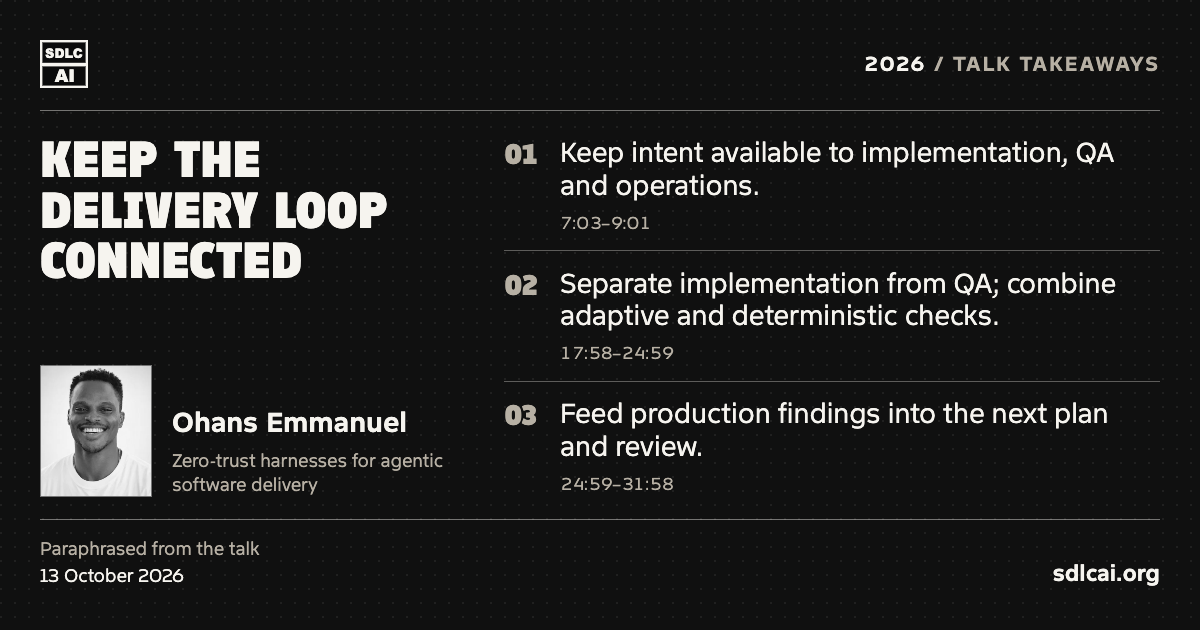
Keep the delivery loop connected Three takeaways from Ohans Emmanuel at SDLCAI 2026: 1. Keep intent available to implementation, QA and operations. 2. Separate implementation from QA; combine adaptive and deterministic checks. 3. Feed production findings into the next plan and review. Paraphrased from “Zero-trust harnesses for agentic software delivery”. Watch the full talk: https://www.youtube.com/watch?v=xi1AY-G3Ycc #SDLCAI
Image alt text
Keep the delivery loop connected. Ohans Emmanuel at SDLCAI 2026. Three paraphrased talk takeaways: 1. Keep intent available to implementation, QA and operations. 2. Separate implementation from QA; combine adaptive and deterministic checks. 3. Feed production findings into the next plan and review. sdlcai.org
Key points
Paraphrased from the talk. Follow each timestamp to hear the argument in context.
Keep shared intent accessible throughout delivery so implementation, QA and operations can refer to the same goal.
7:03–9:01Review implementation decisions early and use model pairing during the build to catch consequential errors before a large diff accumulates.
9:02–13:04Retain a human understanding of system architecture and data flow even when agents produce most changes.
14:49–17:58Separate the implementing agent from QA and combine adaptive checks with deterministic assertions and exploratory testing.
17:58–24:59Connect production signals and feed root-cause learning into the next task, plan and review.
24:59–31:58
The talk in context
Ohans Emmanuel presents the practices his team uses to produce software with coding agents while retaining engineering judgement. A plan or statement of intent must remain accessible to the whole team and to later stages of delivery. Reviewing implementation decisions early can catch a wrong premise before it generates a large diff. His team pairs different models during implementation, focusing escalation on consequential issues rather than endless nitpicks. Visual representations of changes help engineers retain a mental model of architecture and data flow. Independent QA agents exercise preview deployments, combining adaptive interaction with deterministic assertions, and exploratory checks look beyond predefined paths. After deployment, monitoring signals are connected across services and agent traces. Findings feed back into tasks and implementation plans, so the value lies in the connected feedback loop as well as in the individual checks.
Context & qualifications
- These practices describe the speaker’s team experience. Pairing models and using a separate QA agent add scrutiny, without establishing independent failure modes. Read-only infrastructure access still requires controls over data disclosure.
Continue with another talk
Explore related questions across the seminar.
Generation changes the delivery system
Viljami Kuosmanen
I Let Non-Engineers Vibe-Code Our Production Codebase
Generation changes the delivery system
Sini Tistelgrén
AI Factory doesn't eliminate the fundamentals
Shared context includes the reasons behind decisions
Muhammad Waseem