SDLCAI 2026 / Talk summary
Muhammad Waseem
Code Was Never the Hard Part. Understanding Was—and Still Is.
Muhammad Waseem argues that AI makes code generation easier while understanding, integration and ownership remain difficult. He examines repository context, decision rationale and agent-facing applications, then proposes deterministic checks, human judgement and gates for safety, architectural fit and measurable value.
- system understanding
- code review
- repository context
- decision records
- agent memory
- replaceable architecture
- verification
Takeaway graphic
Share three selected takeaways from this talk. Download a landscape or portrait card, with suggested post copy and image alt text.

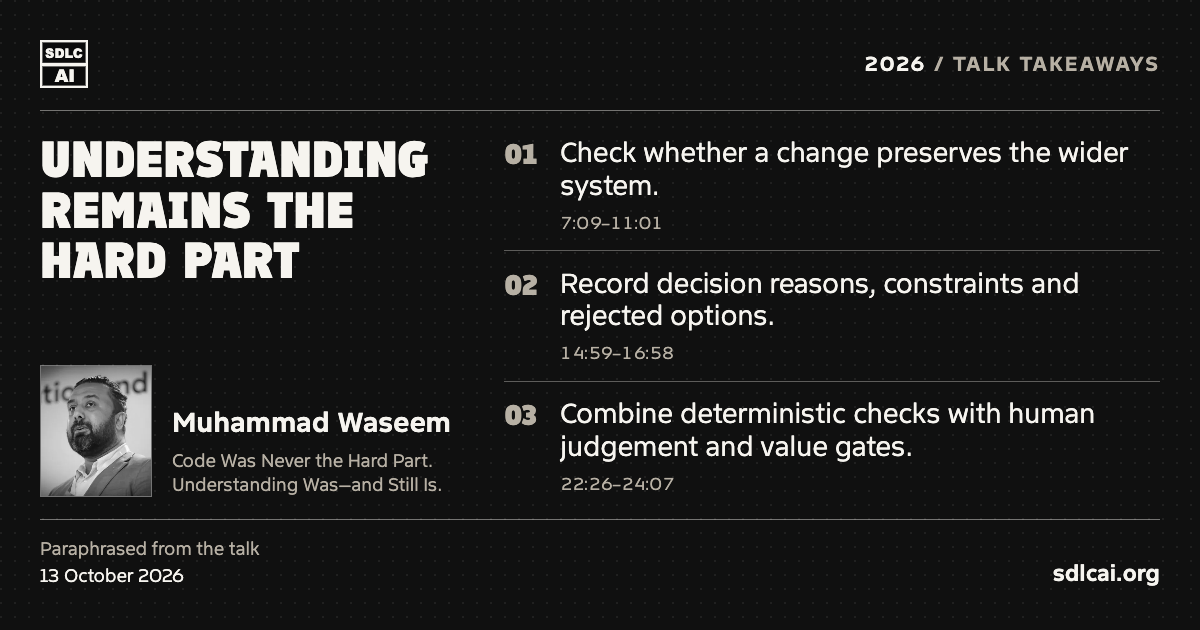
Read post copy & alt text
Suggested post copy
Understanding remains the hard part Three takeaways from Muhammad Waseem at SDLCAI 2026: 1. Check whether a change preserves the wider system. 2. Record decision reasons, constraints and rejected options. 3. Combine deterministic checks with human judgement and value gates. Paraphrased from “Code Was Never the Hard Part. Understanding Was—and Still Is.”. Watch the full talk: https://www.youtube.com/watch?v=o_WaA-EaBqo #SDLCAI
Image alt text
Understanding remains the hard part. Muhammad Waseem at SDLCAI 2026. Three paraphrased talk takeaways: 1. Check whether a change preserves the wider system. 2. Record decision reasons, constraints and rejected options. 3. Combine deterministic checks with human judgement and value gates. sdlcai.org
Key points
Paraphrased from the talk. Follow each timestamp to hear the argument in context.
Measure whether generated changes fit and preserve the system, rather than judging a file or snippet in isolation.
7:09–11:01Review and understanding have to keep pace with generated work; more code alone does not remove that constraint.
11:01–14:58Decision rationale, rejected options, constraints and agreement need to be recorded because code does not contain all organisational knowledge.
14:59–16:58Design for replacement of models, tools and agents while retaining ownership of the data and associated knowledge.
21:11–22:26Use deterministic checks, human judgement and explicit gates for safety, architectural grounding and actual value.
22:26–24:07
The talk in context
Muhammad Waseem organises the talk around writing, reading, deciding and caring for software. Faster generation expands the scope in which mistakes can propagate, while file-level success can conceal broken relationships elsewhere in a repository. His account of a Java refactoring study motivates attention to dependencies and system-level evaluation. He then examines how review capacity, limited agent memory and unwritten organisational knowledge constrain adoption. Decision reasons, rejected options and ownership are not fully represented by source code. Looking ahead to applications whose users include other agents, he discusses intent, contracts and the ability to replace models, tools and agents while retaining control of data and knowledge. His proposed response combines deterministic checks with human evaluation of consequential cases, and asks whether a change is safe, grounded in its environment and producing the intended value.
Continue with another talk
Explore related questions across the seminar.
Shared context includes the reasons behind decisions
Ohans Emmanuel
Zero-trust harnesses for agentic software delivery
Shared context includes the reasons behind decisions
Viljami Kuosmanen
I Let Non-Engineers Vibe-Code Our Production Codebase
Shared context includes the reasons behind decisions
Sini Tistelgrén