SDLCAI 2026 / Talk summary
Jussi Hacklin
Driving AI adoption above targets in highly regulated environment
Jussi Hacklin describes how Elisa supports AI adoption within regulatory and customer-contract constraints. Legal collaboration, clear leadership expectations, practical guidance, shared tooling and bounded experiments form the basis for adoption across the software lifecycle.
- AI adoption
- regulated environments
- developer communities
- tool governance
- shared context
- token budgets
- leadership
Takeaway graphic
Share three selected takeaways from this talk. Download a landscape or portrait card, with suggested post copy and image alt text.

Read post copy & alt text
Suggested post copy
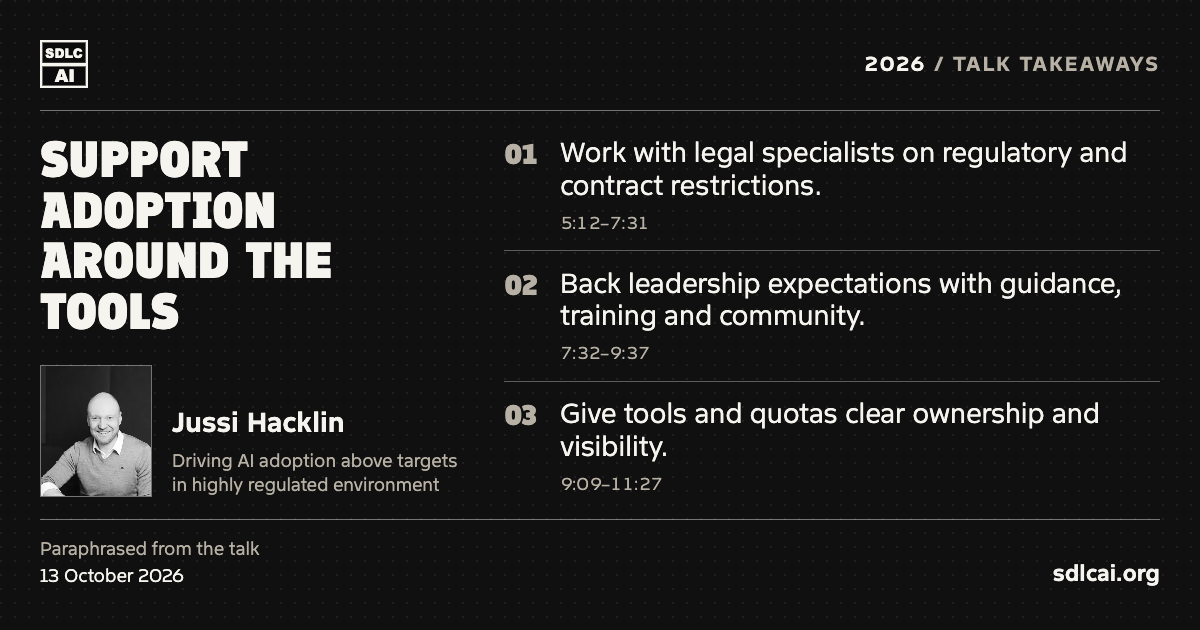
Support adoption around the tools Three takeaways from Jussi Hacklin at SDLCAI 2026: 1. Work with legal specialists on regulatory and contract restrictions. 2. Back leadership expectations with guidance, training and community. 3. Give tools and quotas clear ownership and visibility. Paraphrased from “Driving AI adoption above targets in highly regulated environment”. Watch the full talk: https://www.youtube.com/watch?v=VpoYC7DaOjs #SDLCAI
Image alt text
Support adoption around the tools. Jussi Hacklin at SDLCAI 2026. Three paraphrased talk takeaways: 1. Work with legal specialists on regulatory and contract restrictions. 2. Back leadership expectations with guidance, training and community. 3. Give tools and quotas clear ownership and visibility. sdlcai.org
Key points
Paraphrased from the talk. Follow each timestamp to hear the argument in context.
Regulatory obligations and customer-contract restrictions need active legal collaboration, rather than a single blanket rule for every part of the company.
5:12–7:31Clear management expectations should be backed by accessible guidance, training and a developer community.
7:32–9:37Central tool ownership and quota monitoring provide visibility while allowing teams to request capacity and propose useful additions.
9:09–11:27Sandboxed experiments can test new development approaches without imposing every brownfield constraint on the experiment.
11:28–12:19Shared context and feedback should connect product creation, development and operations; leadership should keep communicating the direction while adapting the tools.
13:59–20:37
The talk in context
Jussi Hacklin describes Elisa's progression from individual AI experiments toward broader use across software development, testing and maintenance. Regulation and customer contracts constrain which tools and data flows are available, so the organisation works with legal specialists and established vendors while separating especially restricted areas from the wider operation. Practical support includes concise guidance, training, a developer portal, a community for sharing experience and central management of tools and quotas. Sandboxed greenfield experiments provide space to try different development approaches. Jussi also sketches a development model connecting product creation, engineering and operations through live, secure organisational context and feedback. He emphasises that adoption depends on people understanding the direction and expectations, alongside a curated tool portfolio that can change as capabilities, pricing and constraints evolve.
Context & qualifications
- This account reflects Elisa’s operating context at the October 2026 event. Security depends on how components and data flows work together, as well as on the individual tools.
Continue with another talk
Explore related questions across the seminar.
Adoption depends on usable assets and room to learn
Mo Khazali
1978: The Last Good Year
Adoption depends on usable assets and room to learn
Jenni Kylmäkoski
Why Leaders Should Use AI Themselves and Eat Their Own Dog Food?
Adoption depends on usable assets and room to learn
Viljami Kuosmanen