SDLCAI 2026 / Talk summary
Jenni Kylmäkoski
Why Leaders Should Use AI Themselves and Eat Their Own Dog Food?
Jenni Kylmäkoski explains why leaders should build and use AI tools themselves. Her reporting tools and an unintended Jira change reveal practical lessons about onboarding, permissions, observability, learning time and maintaining shared AI assets as products.
- leadership
- AI adoption
- developer experience
- least privilege
- observability
- learning
- AI asset maintenance
Takeaway graphic
Share three selected takeaways from this talk. Download a landscape or portrait card, with suggested post copy and image alt text.

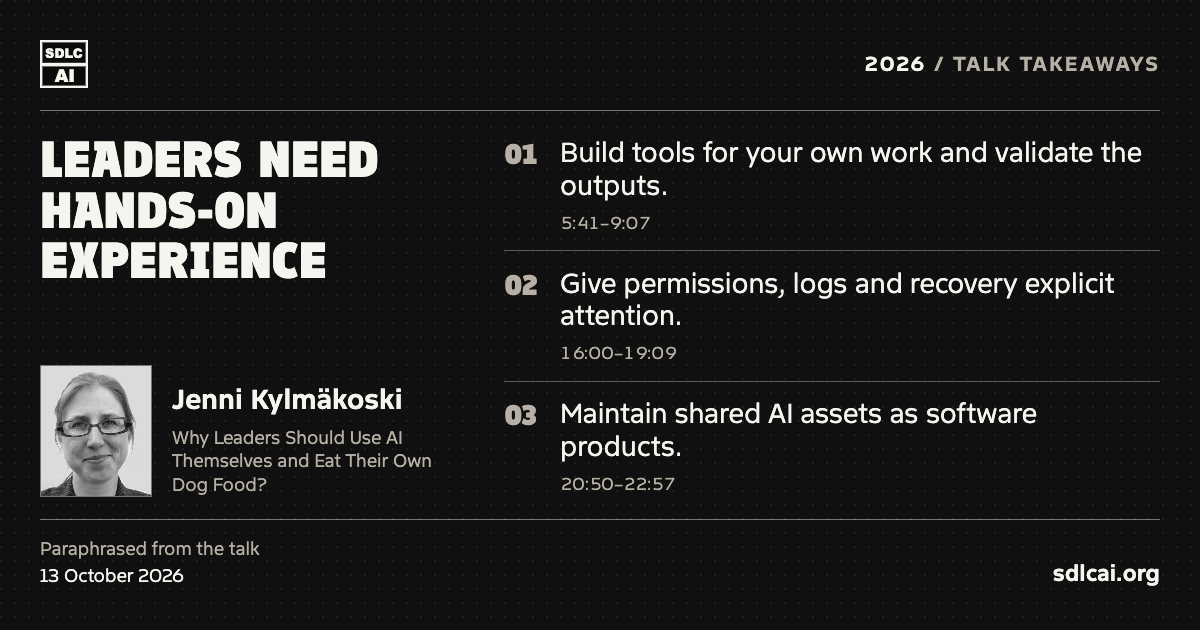
Read post copy & alt text
Suggested post copy
Leaders need hands-on experience Three takeaways from Jenni Kylmäkoski at SDLCAI 2026: 1. Build tools for your own work and validate the outputs. 2. Give permissions, logs and recovery explicit attention. 3. Maintain shared AI assets as software products. Paraphrased from “Why Leaders Should Use AI Themselves and Eat Their Own Dog Food?”. Watch the full talk: https://www.youtube.com/watch?v=1bT23mhlzGg #SDLCAI
Image alt text
Leaders need hands-on experience. Jenni Kylmäkoski at SDLCAI 2026. Three paraphrased talk takeaways: 1. Build tools for your own work and validate the outputs. 2. Give permissions, logs and recovery explicit attention. 3. Maintain shared AI assets as software products. sdlcai.org
Key points
Paraphrased from the talk. Follow each timestamp to hear the argument in context.
Leaders can learn the development experience by building tools for their own recurring work and validating the outputs.
5:41–9:07Onboarding, documentation, training and support shape whether shared AI assets are actually used.
9:07–11:34A model change can alter tool behaviour; least privilege, logging and recovery deserve explicit attention.
16:00–19:09Learning time must be included in priorities and delivery plans, or urgent commitments will displace it.
19:20–20:50Shared AI assets need a product lifecycle with requirements, tests, releases, documentation and maintenance.
20:50–22:57
The talk in context
Drawing on her work as an R&D leader at Nokia, Jenni Kylmäkoski argues that leaders need direct experience of the changes they ask teams to make. She builds small applications for recurring reporting and analysis, using the same tools as her developers and checking the generated results. This exposes installation friction, documentation gaps and the support people need to adopt new capabilities. A model change unexpectedly reopened closed Jira tickets during a reporting task, prompting her to reconsider permissions, logs and recovery. She also describes the tension between delivery commitments and time spent learning. Her conclusion is that an organisation's prompts, skills, agents, workflows and monitoring need requirements, testing, distribution, documentation and ongoing maintenance, just as other software products do. Practical participation helps leaders understand both the technology and the people living through the transition.
Continue with another talk
Explore related questions across the seminar.
Verification needs clear ownership and bounded permissions
Viljami Kuosmanen
I Let Non-Engineers Vibe-Code Our Production Codebase
Adoption depends on usable assets and room to learn
Mo Khazali
1978: The Last Good Year
Verification needs clear ownership and bounded permissions
Ohans Emmanuel