SDLCAI 2026 / Talk summary
Zak Allal
Medical Breakthroughs and Scientific Discoveries
Zak Allal argues that lowering the cost of repeating experiments can change scientific discovery. He describes a clinical research system built with supercomputing, Rust, Julia and C++, and presents a proposed continuous hearing atlas as an example of questioning the assumptions behind existing categories.
- scientific computing
- repeatable experiments
- research infrastructure
- supercomputing
- multidisciplinary research
- hearing research
- problem framing
Takeaway graphic
Share three selected takeaways from this talk. Download a landscape or portrait card, with suggested post copy and image alt text.

Read post copy & alt text
Suggested post copy
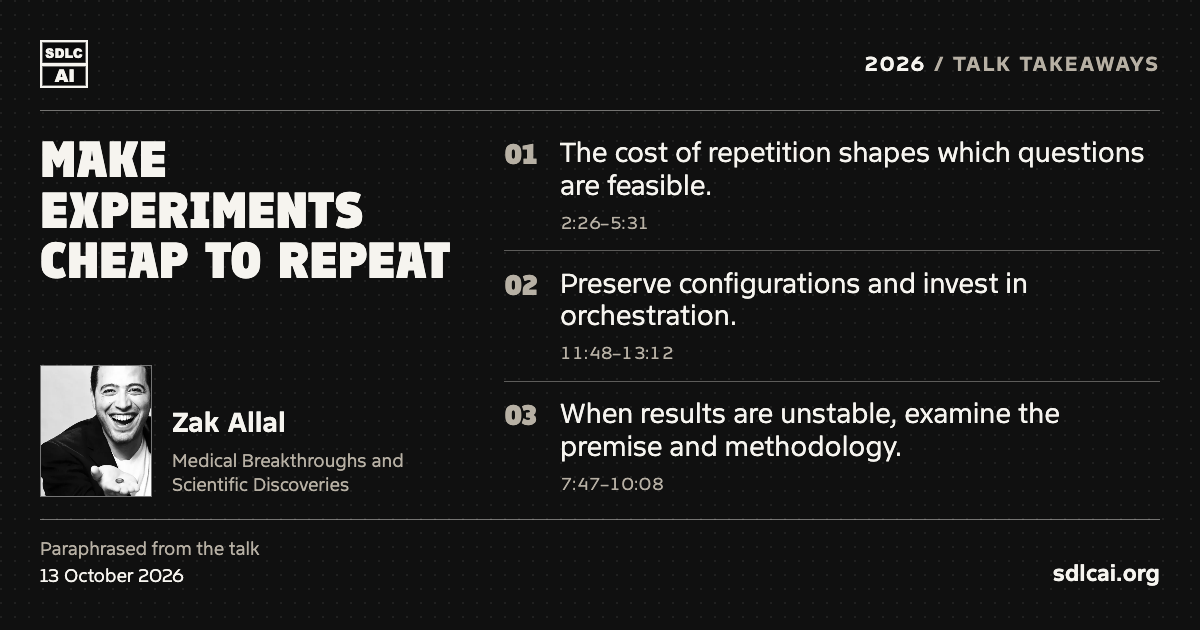
Make experiments cheap to repeat Three takeaways from Zak Allal at SDLCAI 2026: 1. The cost of repetition shapes which questions are feasible. 2. Preserve configurations and invest in orchestration. 3. When results are unstable, examine the premise and methodology. Paraphrased from “Medical Breakthroughs and Scientific Discoveries”. Watch the full talk: https://www.youtube.com/watch?v=gVXx5fOUXbs #SDLCAI
Image alt text
Make experiments cheap to repeat. Zak Allal at SDLCAI 2026. Three paraphrased talk takeaways: 1. The cost of repetition shapes which questions are feasible. 2. Preserve configurations and invest in orchestration. 3. When results are unstable, examine the premise and methodology. sdlcai.org
Key points
Paraphrased from the talk. Follow each timestamp to hear the argument in context.
The cost of repeating an experiment influences which questions researchers can afford to investigate.
2:26–5:31Architecture, orchestration and repeatable configurations can be as important as adding a predictive model.
11:48–13:12Unstable results can justify examining the original premise and methodology rather than choosing another model.
7:47–10:08The proposed hearing atlas is presented as research under review, not an established clinical standard.
16:21–19:27Curiosity and collaboration across engineering and domain expertise help define worthwhile experiments.
19:28–20:44
The talk in context
Zak Allal links software architecture and multidisciplinary curiosity to the practical ability to repeat scientific experiments. A weather-checking analogy introduces the cost of time, effort and repetition; he then applies that idea to research tooling and supercomputing. He describes a container-based clinical research system using Rust, Julia and C++ to orchestrate repeatable analyses of hearing data. Repeated experiments produced inconsistent categories, prompting him to question the premise that hearing should be represented as discrete types. He presents a proposed five-dimensional hearing atlas and describes methodological issues he believes affected earlier work, including discretisation and treating paired observations as independent. At the event, he states that the paper is a preprint undergoing review and discusses an intention to seek regulatory qualification. The reusable engineering lesson is to make experiments cheap to rerun, preserve their configuration and remain willing to challenge the question being asked.
Context & qualifications
- At the event, the proposed hearing model was presented as a preprint under review, with an intention to seek regulatory qualification. This research status does not imply completed peer review or regulatory approval.