SDLCAI 2026 / Talk summary
Joongi Shin
Generative UI for users, not just for designers
Joongi Shin studies generative UI for people who want to complete a task, rather than design an interface. His comparison of prompts, editable subtask representations and follow-up surveys shows why helping users form and express their intentions matters alongside generating working software.
- generative UI
- human-computer interaction
- user intent
- usability
- user research
- envisioning
- clarification questions
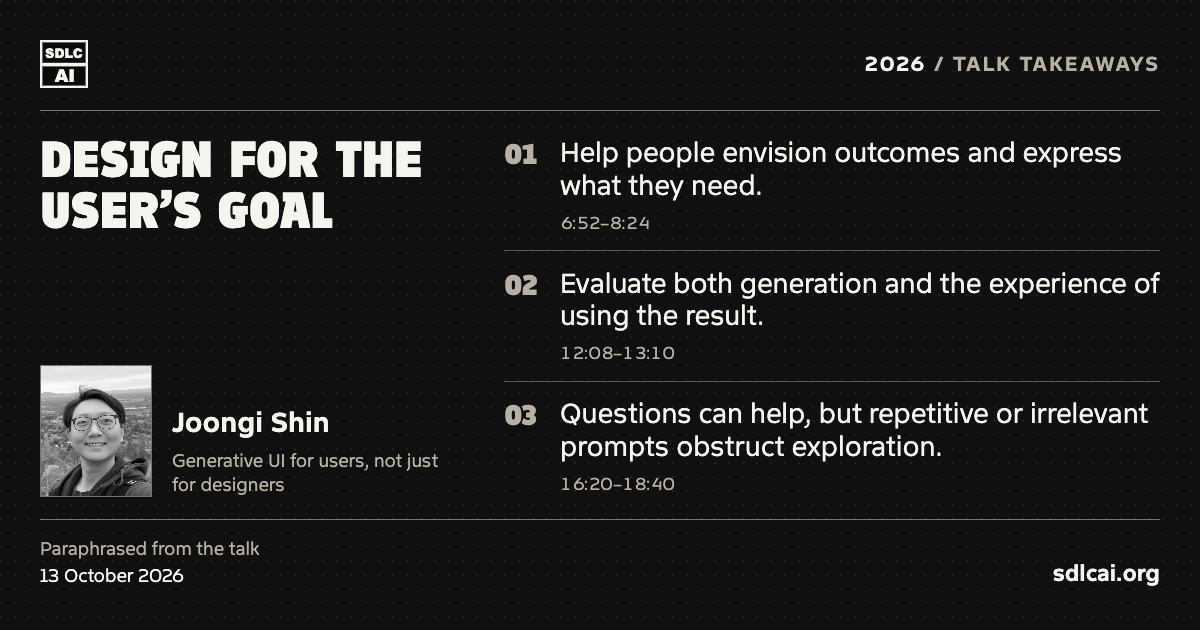
Takeaway graphic
Share three selected takeaways from this talk. Download a landscape or portrait card, with suggested post copy and image alt text.

Read post copy & alt text
Suggested post copy
Design for the user’s goal Three takeaways from Joongi Shin at SDLCAI 2026: 1. Help people envision outcomes and express what they need. 2. Evaluate both generation and the experience of using the result. 3. Questions can help, but repetitive or irrelevant prompts obstruct exploration. Paraphrased from “Generative UI for users, not just for designers”. Watch the full talk: https://www.youtube.com/watch?v=JTTq9MNefTU #SDLCAI
Image alt text
Design for the user’s goal. Joongi Shin at SDLCAI 2026. Three paraphrased talk takeaways: 1. Help people envision outcomes and express what they need. 2. Evaluate both generation and the experience of using the result. 3. Questions can help, but repetitive or irrelevant prompts obstruct exploration. sdlcai.org
Key points
Paraphrased from the talk. Follow each timestamp to hear the argument in context.
Task-oriented users and designers have different goals and willingness to edit detailed interface specifications.
2:29–5:02Envisioning a useful outcome and expressing it in a prompt are separate sources of difficulty.
6:52–8:24Evaluate the process of generating an interface and the experience of using it, rather than the generated artefact alone.
12:08–13:10In the reported study, subtask–UI interaction felt least usable and prompt-only interaction felt least aligned with intent.
13:10–15:32Follow-up questions can reduce articulation effort, but persistent or irrelevant questioning can also obstruct exploration.
16:20–18:40
The talk in context
Joongi Shin asks whether generative UI approaches developed for designers also help everyday, task-oriented users. He explains the challenge of envisioning what an interface should do and articulating that intention to a model. A study with 30 participants compared prompt-only interaction, editable subtask–UI representations and a prompt-survey approach, examining both interface generation and subsequent use. He reports that subtask–UI interaction felt least usable, while prompt-only interaction felt least aligned with users' intentions. Experiences during generation were associated with perceptions of the resulting interface, and participants' prior experience also mattered. Follow-up questions offered useful support for envisioning and articulation, but could become repetitive or miss what users were trying to achieve. His conclusion is to design for the user's actual goal: help people discover what they need without requiring them to become interface designers.
Context & qualifications
- The findings concern perceptions in the described study. Associations between generation effort and later usability perceptions do not establish causation or a universally best interaction method.
Continue with another talk
Explore related questions across the seminar.
Use outcome measures and preserve their denominators
Mo Khazali
1978: The Last Good Year
Building can be part of discovering the problem
Tapio Pitkäranta
The Agentic Probe: The Instrument of Agentic Discovery & Engineering
Use outcome measures and preserve their denominators
Viljami Kuosmanen